Duplicate documentation cannot be solved by reducing professional responsibility. It requires better information flows. This article shows how everyday entries, goal links, context and digital workflows can reduce repeated work.
Duplicate documentation often does not arise from a lack of care. It arises from separate systems, media breaks and different proof requirements. An everyday situation is observed, later written down, then transferred into reports and perhaps reformulated once more for service records or funding bodies.
The more effective approach is therefore not: document less professionally.
It is: capture information closer to everyday life, review it professionally and then reuse it in a meaningful way.
The first part explained why duplicate documentation happens in disability support. This article shows how organisations can reduce that repeated work in practice without weakening the professional quality of documentation.
When everyday entries become a better foundation
Many relevant situations do not happen at a desk. They happen in everyday life: while cooking, in the workshop, during leisure activities, when arriving in the group or in small moments of independence.
When these situations are reconstructed from memory hours later, details get lost. Sometimes only a short note remains. Sometimes a vivid situation becomes a formulaic sentence. And sometimes the exact context that would matter professionally is missing: What was the goal? What support was needed? What did the person experience? What change became visible?
Everyday entries can create a better foundation here. They can be short observations, photos, audio recordings, simple ratings or symbol-based feedback. The decisive point is that such entries do not replace professional documentation. But they give support professionals information closer to the moment about what happened and why it may be relevant.
Support professionals review this information, place it in a professional context and decide what should be transferred into documentation or supplemented. This does not create automatic documentation without responsibility. It creates a better starting point for professional documentation.

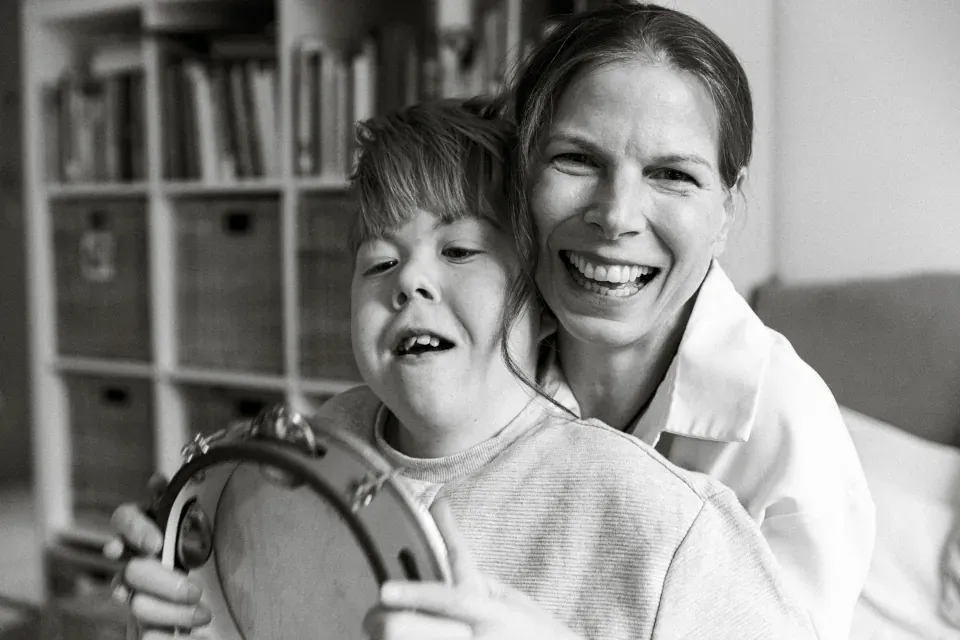
Everyday life can be captured more directly when people can record moments as they happen.
Why everyday entries can be more than text
Especially in disability support, important information does not always appear as a fully written report.
A photo can show that a person started an action independently. An audio recording can capture a mood or reaction. A symbol can express how someone experienced a situation. A short rating can make visible whether an activity felt helpful, demanding or enjoyable.
This is especially relevant for people who do not communicate, or do not communicate exclusively, through written language. Their perspective is easily lost in traditional documentation processes because professionals later have to translate it into their own words.
Everyday entries do not replace professional interpretation. But they can create a closer, more personal and more person-centred foundation for it.
Good documentation needs context
Person-centred documentation is more demanding than a simple activity record. It needs to capture not only that something happened, but also why it matters professionally. This is closely connected to the ICF. The WHO describes the ICF as both a classification and a terminology for health-related domains; because functioning and disability always happen in a context, the ICF also includes environmental factors. (World Health Organization)
For disability support, that is central. An observation is rarely meaningful on its own. The context matters:
- What does the situation relate to?
- Which goal was being worked on?
- What support was needed?
- What changed compared with before?
- Which barrier became visible?
- Which resource could be used?
That is why it is not enough to store everyday events somewhere. Good documentation connects everyday life, goals, activities, observations and professional judgement. This is exactly where many processes fail today: information exists, but it is spread across notes, reports, handovers, paper folders, software fields and forms. When a review or report is due, it has to be searched for and assembled with considerable effort.
The lever: capture once, reuse meaningfully
A strong principle against duplicate documentation is the once-only principle: information should be captured once and then reused in a meaningful way.
In the Brüsseler Kreis study, proposed relief measures include a once-only principle, nationwide standardised digital interfaces and binding data models. The study also mentions reducing and prioritising documentation requirements, documenting deviations instead of writing full reports, and digital tools such as speech recognition. (DVFR Reha-Recht)
That sounds technical, but at its core it is a professional issue.
When an observation is captured once in everyday life, it should not have to be rewritten in every subsequent process. It should be usable as a foundation for handover, progress documentation, goal work, reports and proof of services — of course with clear roles, permissions and professional review.
This does not create automatic documentation without responsibility. It creates a better path for information.
Existing specialist software is not the enemy
Many organisations work with established systems for billing, shift planning, administration or specialist service documentation. These systems fulfil important tasks and cannot simply be replaced.
The more effective lever often lies before that point: with the information that arises in everyday life and later has to be transferred into those systems with considerable effort. If everyday entries, observations and goal links are better prepared, professionals have to reconstruct less. They can review existing information, add professional context and bring it into the required form. That does not reduce professional responsibility; it reduces the unnecessary path toward it.
Document deviations instead of retelling every day
Another important idea is deviation-based documentation.
Not every stable routine needs a long free-text entry every day. When support happens as planned, this can often be recorded in a structured and concise way. More detailed documentation is needed when something professionally relevant deviates from the plan: a development step, a crisis, a new barrier, a changed support need or a special observation. This does not only relieve professionals. It can also improve the quality of documentation because attention is directed more strongly toward what is truly relevant.
The important point is: deviation-based documentation only works when the foundation is clear. Goals, support planning and regular routines must be described clearly; otherwise, it is not possible to understand what a situation deviates from.
Digital documentation must not merely rebuild paper
Many digitalisation projects fail because old forms are simply translated into digital screens.
The paper may disappear, but the logic remains the same: fill in fields, copy texts, transfer proof, search for information. That is not real relief. It is digitised duplicate work.
Curacon describes for disability support in 2026 that organisations already map many administrative and communication processes digitally, while innovative technologies such as AI tools, assistive systems or digital assistants are still at an early stage. At the same time, interface problems, data protection, IT security and digital skills are named as central barriers. (Curacon)
Real relief does not come from more software alone. It comes when software changes the workflow:
- Information is captured where it arises.
- Entries are connected with goals and activities.
- Support professionals can add, review and interpret information.
- Relevant information can be found again later.
- Reports are created from existing, structured foundations rather than from repeated copying.
Duplicate documentation is also a workforce issue
Disability support is already under pressure. The Curacon 2022 study showed that 79 percent of surveyed service providers were strongly affected by the shortage of skilled staff. At the same time, 85 percent agreed with the statement that the BTHG was a “bureaucratic monster”. (Curacon)
Current data on occupational health also shows how strained the situation is. The BGW Trend Report Disability Support 2025 reports, among other things, a 32 percent increase in days of incapacity for work among professionals in disability support from 2021 to 2022. (BGW)
Duplicate documentation is therefore not only a process issue. It is a staffing issue. Every unnecessary transfer increases pressure on teams that already work with limited resources.
Improving documentation processes does not simply create efficiency. It creates better conditions for professional work.
What organisations can check in practice
Organisations that want to reduce duplicate documentation can start with a few guiding questions:
- Where is the same information captured multiple times?
- Which records are truly necessary from a professional or legal perspective?
- Which documentation only exists because systems do not communicate with each other?
- Which information is observed in everyday life but only written down much later?
- Are goals, activities and observations connected?
- Can support professionals document easily, mobile and close to the moment?
- Are data protection, role permissions and traceability considered from the beginning?
The associations representing people with disabilities explicitly call for documentation to be standardised and brought together, for shared data use to be enabled and for resources freed up through reduced bureaucracy to be invested in person-centred and community-oriented professional collaboration. (Caritas)
That is a useful benchmark: reducing bureaucracy must not mean that professional quality becomes less visible. It should mean that the truly important information becomes more visible.
Conclusion: less duplicate work, more professional clarity
Duplicate documentation does not arise because support professionals lack structure. It arises because everyday observations, goal work, proof of services, quality reviews and billing are often organised in separate systems.
That is why it is not enough to shorten individual forms or replace paper with digital screens.
The more effective path is a documentation practice that captures information closer to everyday life, places it in a professional context and makes it meaningfully reusable. In this way, documentation can become what it should be: a shared foundation for support, participation, quality and traceability.
Less duplicate documentation does not mean less professional care.
At best, it means more time for people and better documentation where it truly matters.
Learn more
With the Independo Journal, people can capture everyday experiences using symbols, photos, audio and simple inputs. In the Independo Portal, support professionals can review these entries in an organisational context, add professional interpretation and make them usable for documentation.
Learn more about the Independo Portal
Learn more about the Independo Journal
Read the data processing information