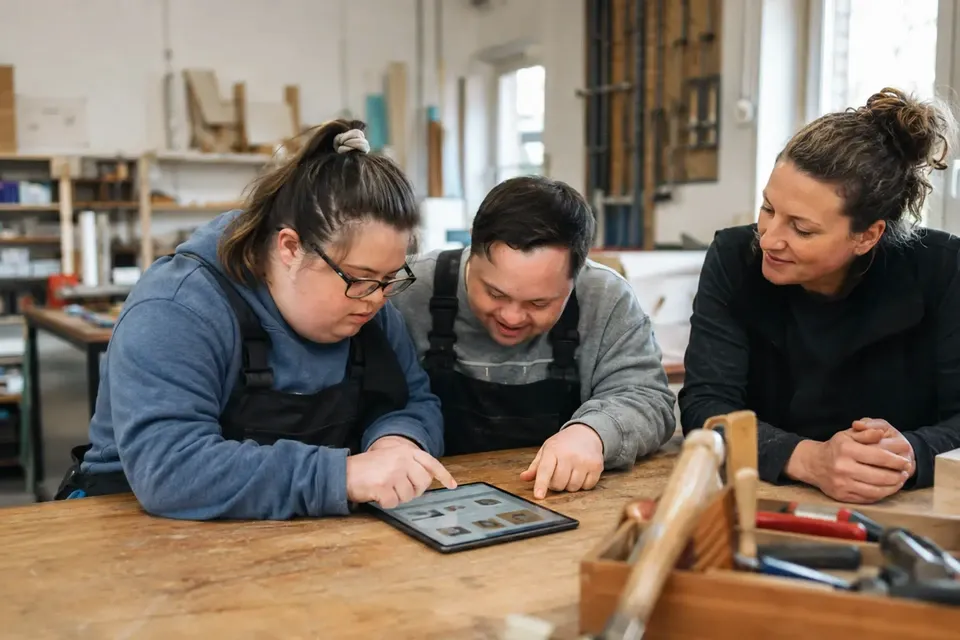
Digital processes do not automatically create participation. What matters is whether people can understand, decide, and contribute in their everyday lives.
Digital Participation, Not Just Digital Administration
An appointment is rescheduled. The change appears immediately in the organisation’s system. The responsible support professional can see it. Yet the person whose appointment it is only learns about the change later, or receives the information in a form they cannot interpret themselves.
The process is digital. It still does not enable participation.
Digital tools can shorten workflows, make information available sooner, and reduce breaks between systems. That matters. But good digitalisation in disability support involves more than transferring existing administrative processes onto a screen. It also depends on whether people can understand what is happening, contribute their perspective, and influence decisions.
Three Dimensions of Digital Participation
Digital participation cannot be reduced to access to the internet, a smartphone, or a tablet. A model developed in the context of German disability support distinguishes three dimensions. The first covers access to digital technology, including devices, connectivity, and suitable learning opportunities. The second describes participation through technology, when a digital tool enables communication, planning, orientation, or other everyday activities. The third concerns participation within digital spaces: contributing content, influencing decisions, and helping to shape digital environments. (Albrecht and Hüning: A model of digital participation)
These dimensions are connected. A tablet alone does not create participation. An application may be technically accessible while offering no suitable way to communicate or make a choice. An administrative process may run efficiently even though the person’s perspective remains absent from it.
The important question is therefore not only whether someone can open a digital service. It is what they can understand, decide, and do with it in their everyday life.
When Support Becomes Substitution
Many digital services quietly assume a particular kind of user. Forms require complex written language. Information is spread across several screens. Logging in may depend on remembering passwords, number sequences, or having another device close at hand. Missing one step can mean starting again.
In these situations, support professionals or family members often step in. They want to prevent a missed appointment, an expired deadline, or the loss of important information. Under time pressure, taking over the device and completing the task can seem like the most practical option.
The task is completed. The person’s decision may nevertheless disappear from the process.
This is not simply a failure by individual support professionals. The system often leaves little room for another form of assistance. It may provide no understandable intermediate steps, no suitable means of expression, and no way to prepare a choice together before the person confirms it themselves.
Support and self-determination are not opposites. The problem arises when support repeatedly replaces the person’s own decision.
An accessible process could work differently. A support professional explains two possible appointments in understandable language. The person can see both options in their calendar, recognise them through familiar symbols, and make the selection. The support professional can help with the controls where needed. The decision remains with the person.
Potential Is Not Enough
Everyday digital technology can support communication, daily activities, and participation in community life. A recent scoping review examined 151 studies involving adults with intellectual disabilities. Its findings point particularly to the importance of adaptable and personalised technology. The authors also note that the effects on participation have not yet been studied sufficiently across every area of life. (Braun et al.: Current digital consumer technology)
Organisations should therefore avoid assuming that one interface will work for everyone. Nor should technical usability be treated as proof of participation. People use different forms of communication, bring different experiences, and require different kinds of support.
Guidelines Are a Tool, Not Proof of Participation
The W3C guidance on cognitive accessibility helps teams examine known barriers systematically. Its recommendations include making the purpose of each page clear, using familiar controls, explaining individual steps, allowing people to correct mistakes, and avoiding authentication that depends entirely on remembering abstract strings of characters. The guidance also addresses personalisation, alternative formats, and access to human help. (W3C: Making Content Usable for People with Cognitive and Learning Disabilities)
These guidelines are a useful starting point. They help teams avoid overlooking common barriers. Following them does not, on its own, prove that a digital service is understandable, usable, or supportive of participation in everyday life.
The same applies to pictures and symbols. Adding an arbitrary pictogram does not automatically make communication accessible. Symbols need to be familiar or tested together with the people using them. Depending on the person, photos, audio, plain language, or other forms of Augmentative and Alternative Communication may also be appropriate.
No guide can fully predict which terms are familiar, how someone experiences a work step, or which decision matters to them at a particular moment. That requires the involvement of the people who will use the software.
Co-Design Starts Before the First Draft
Co-design is more than asking people to test an almost finished interface. People should be able to influence which problem is addressed, which everyday situations matter, and how everyone will judge whether a solution works.
The methods themselves also need to be accessible. Fast workshops, abstract wireframes, and long discussion rounds can create new barriers. Concrete situations, understandable materials, sufficient time, and different ways to express an opinion make participation more possible. A qualitative study covering two technology projects illustrates the importance of individual adaptation and thoughtful facilitation within such design processes. (Safari, Wass and Thygesen: One Size Does Not Fit All)
Participation must not end with feedback. People who will use an application need meaningful influence over product decisions, including its language, symbols, workflows, privacy choices, and testing in everyday settings.
Guidelines support the craft of accessible design. The experience of the people using the software determines whether that work results in a good solution.
Digital Participation Is an Organisational Responsibility
An accessible interface can remove many barriers. It cannot make up for a lack of time, unclear responsibilities, or restrictive infrastructure on its own.
Research on digital participation in disability support describes an interaction between personal, technological, and environmental factors. These include available support, digital skills within a person’s environment, and staff readiness to use technology. These relationships are not a reason to place responsibility on individual support professionals. They show that organisations need to create suitable working conditions. (Albrecht and Hüning: Digital participation of people with intellectual disabilities)
Support professionals do not simply need another application. They need time to explore new workflows together with the people they support, clear responsibilities, and confidence about privacy and access rights. The technical infrastructure also needs to work. A personal device offers little value if there is no reliable internet connection or its use is heavily restricted.
Digital participation should not become an additional task carried informally by a few committed staff members. It belongs in the design of workflows, training, procurement, and support arrangements.
Connecting Planning, Everyday Perspectives, and Organisational Workflows
For Independo, digital participation means connecting an accessible interface for the person with the workflows of the people and organisations around them.
The Independo Calendar can display appointments and daily routines using pictures and symbols. The purpose is not merely to let someone else manage a schedule. People should be able to recognise what is planned and participate in organising their time.
The Independo Journal allows experiences and personal perspectives to be captured through symbols, photos, audio, or simple entries. This makes it possible to create an entry closer to the moment in which something happened.
When the Journal is used within an organisation, its entries become visible in the Independo Portal. Support professionals review the entries and decide whether they should be included in professional documentation, supplemented, or not used. The Journal is not institutional documentation. Its entries do not automatically become official documentation records. Responsibility for professional review and interpretation remains with support professionals.
The participation-oriented aspect lies in this connection: a person’s own perspective can enter an organisational workflow without replacing professional responsibility.
Stellwerk Papenburg offers one example of how this can work in practice. Support professionals there report that participants complete and edit entries more independently. The application also makes it easier for participants to maintain an overview of the work they have completed and the goals they are currently working towards. Goals can therefore become more visible and present in everyday life, rather than appearing only in the organisation’s professional documentation. Stellwerk Papenburg practice report
This is an account from one vocational education setting, not general evidence of impact. It does show how accessible input and a professional workflow can work together.
Start Small and Learn Together
Organisations do not need to change every workflow at once. A clearly defined process is often the better starting point, such as weekly planning, choosing an appointment, or reflecting on a working day.
Together with the people involved, teams can ask:
- What does the person want to understand, decide, or record themselves?
- Which barriers exist in the current process?
- Which language, symbols, or other forms of expression are appropriate?
- Where is support needed, and how does the decision remain with the person?
- Which roles, access rights, and privacy questions need to be clarified?
- How will everyone recognise whether greater participation has become possible?
The final question changes the measure of success. Processing time and completeness still matter. So do understanding, meaningful choices, and the person’s visible contribution.
A first use case should not only be configured technically. The people who will use it should be involved from the beginning and retain influence throughout testing and iteration. This allows an organisation to learn what works in its particular setting and where barriers remain.
Asking the Right Question
Digital administration can reduce work for organisations. Digital participation also considers the people whose everyday lives are affected by these processes.
The question is therefore not only: Is the process digital?
It is also: Who can understand, decide, and contribute within it?
Organisations interested in connecting accessible everyday input with responsible professional workflows can learn more about the Independo Journal and the Independo Portal.