
ICF-oriented documentation helps connect everyday situations with goals, participation, contextual factors, and support. This article explains how disability support teams can document daily practice more meaningfully without adding bureaucracy.
Everyday life often produces the information that later matters for goal work. An activity succeeds with less support. An environment becomes a barrier. A person uses symbols to show that they would like to experience something differently.
But in documentation, all of that often becomes one short progress note: “Was unsettled while shopping.”, “Participation in the activity was possible.”, “Needed support.”.
These notes are not wrong. But they often show too little. The connection to goals, participation, environmental factors, and concrete support can quickly get lost. This is exactly where the gap appears between ICF-oriented planning and everyday documentation.
ICF-oriented documentation in daily practice does not mean more technical language, more checkboxes, or more administrative work. It means recording everyday situations in a way that makes their professional meaning visible.
What Does ICF-Oriented Documentation Mean?
The International Classification of Functioning, Disability and Health, or ICF, was developed by the WHO to describe health, functioning, and disability in relation to real-life situations. It does not only look at diagnoses or impairments. It also considers activities, participation, environmental factors, and personal context.
This perspective is especially important in disability support. Support is not only about completing individual tasks. It is about enabling participation.
In the German context, this also connects to the Bundesteilhabegesetz, or Federal Participation Act. Under Section 118 of SGB IX, instruments for needs assessment in Eingliederungshilfe are required to be oriented toward the ICF.
For everyday documentation, however, this does not mean that professionals need to memorize ICF codes or officially code every daily situation. ICF-oriented means something more practical: everyday situations are described in a way that makes goals, activities, barriers, support, and participation visible.
So ICF-oriented documentation does not only ask: “What happened?”
It also asks: “Which activity was involved? What participation was enabled or made more difficult? Which environmental factors helped or created barriers? What support was needed? What does this mean for the person’s goal?”
Why Everyday Situations Matter for Goal Work
Participation goals remain abstract if they are not connected to everyday experience. A goal such as “becoming more independent while shopping” only becomes concrete when documentation shows what worked in the moment, where support was needed, and which conditions played a role.
The ICF distinguishes, among other things, between activities and participation. REHADAT describes activities as the execution of tasks or actions, and participation as involvement in life situations.
For practice, this means that small observations are often professionally relevant.
A person uses a shopping list on their smartphone for the first time. Another person avoids an activity because the room is too crowded. Someone uses a symbol to communicate that they need a break. A support worker adapts the situation so that participation becomes possible again.
These details are not minor. They show what works in everyday life, where barriers emerge, and which forms of support are effective. When they are not recorded close to the moment, they can easily disappear from the professional picture.
The BAR materials on participation planning emphasize the importance of goals, coordination, and the involvement of the person entitled to support. For goal work to remain understandable and traceable, it needs concrete evidence from everyday life.
The Difference: Recording an Event vs. Professional Interpretation
The difference between a thin progress note and documentation that can actually support professional work is often smaller than it sounds. The point is not to turn every sentence into a full report. The point is to avoid leaving out the information that matters.
Thin Documentation
“Mr. M. was unsettled while shopping.”
This sentence describes an event. But it answers very few professional questions. What was the activity? What was the goal? What exactly was difficult? What helped? Was the situation a setback, a sign of an environmental barrier, or an expected support need?
Professionally Interpreted Documentation
“Mr. M. used the shopping list on his smartphone independently. At the checkout area, the environment became loud; he showed signs of stress and needed support while waiting. The app was a facilitating factor; the high level of sensory stimulation at the checkout was a barrier. For the goal ‘complete shopping with less direct guidance,’ the next step remains: practise waiting at the checkout using a previously agreed strategy.”
The same situation has now become more useful.
The documentation names the activity, describes the context and records which support helped. It does not merely claim a facilitating factor or barrier; it shows both in the situation. That makes the connection to the goal traceable.
That is one of the central ideas of the ICF: limitations do not arise only from within the person. They become visible in the interaction between the person, the activity, participation, and the environment.
What Changes Through Professional Interpretation
| A short event note becomes visible as… | Example from the situation |
|---|---|
| Activity | Shopping with a digital list |
| Context | Loud checkout area |
| Barrier | High sensory stimulation while waiting |
| Facilitating factor | Smartphone list supports independence |
| Support | Support while waiting and regulating stress |
| Goal connection | Complete shopping with less direct guidance |
| Next step | Practise a strategy for waiting times |
This connection makes the difference. The progress note does not remain isolated. It becomes part of goal work.
The Role of the Person’s Perspective
ICF-oriented documentation should not only speak about people. Wherever possible, it should also make visible how the person experienced the situation themselves.
This is especially relevant for people who do not primarily communicate through written or spoken language. Augmentative and alternative communication can play an important role here. The Gesellschaft für Unterstützte Kommunikation describes Unterstützte Kommunikation as an umbrella term for measures that enable or expand communication. In disability support, communication is closely connected to involvement and participation.
A digital journal can help make this perspective more visible. A person can record an everyday situation using symbols, photos, audio, simple ratings, or short notes. This creates a personal view of the day: What mattered? What was difficult? What was enjoyable? What should be different next time?
One important boundary is worth making clear: not every journal entry automatically becomes part of professional documentation. But it can be an important starting point for helping professionals connect everyday life, goals, and professional interpretation more effectively.
Professional responsibility remains with support staff. They review, discuss, and contextualize. They connect the person’s perspective with the goal, the context, and the professional assessment. This is exactly how documentation can become more participation-oriented without shifting responsibility for professional documentation onto the person.
What a Practical Workflow Can Look Like
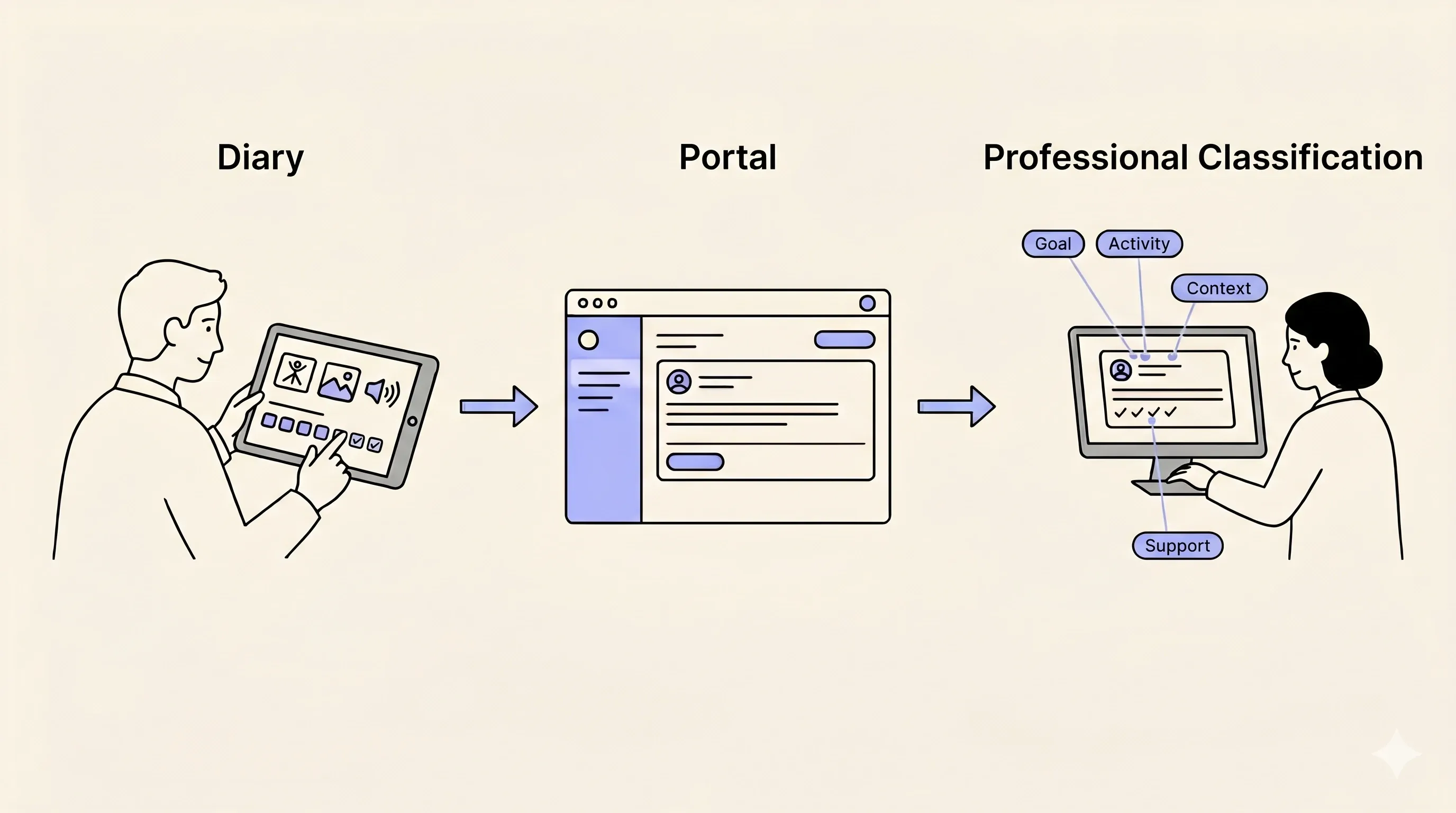
A person records a situation in the Independo Journal. In the Independo Portal, the team sees the entry, reviews it and adds professional context: goal, activity, barrier, facilitating factor or support. Only then can the entry support goal work and documentation.
This workflow does not replace professional assessment. It supports it. The person’s perspective is not simply copied into a report. It is seen, reviewed, and placed into professional context.
This is especially relevant against the background of increasing organizational, documentation, and digitalization demands. The Curacon Eingliederungshilfe 2026 study identifies digitalization and BTHG implementation as important topics for the disability support sector. The key question, however, is whether digital tools merely create additional documentation paths or help connect existing information more effectively.
AI-generated , Show explanation
This image was created entirely with generative AI. It is not a photograph of a real situation.
A workflow in which a diary entry becomes visible in the portal and is then professionally classified in relation to goals, activity, context, and support.
What ICF-Oriented Documentation Does Not Have To Be
In practice, ICF can easily be misunderstood. ICF-oriented documentation does not mean that every everyday situation has to be officially coded. It is also not a medical finding or diagnostic documentation.
What matters is the professional perspective: What happened in everyday life? Which activity was involved? Which barrier or facilitating factor was visible? What kind of support helped? And what does this mean for the agreed goal?
Final reports also do not emerge automatically from individual journal entries. Professional documentation still requires review, context, and responsibility from professionals.
Conclusion: ICF Orientation Needs Connection, Not More Bureaucracy
ICF-oriented documentation should make everyday work in disability support easier to understand, not heavier. Its value lies in connecting concrete situations with goals, activities, barriers, facilitating factors, and participation.
This does not require complicated coding in daily practice. It requires good observation, the person’s perspective, and professional interpretation by support staff.
The result is more than a brief progress note. The team can see what happened, why it matters professionally and which next step may follow.
Learn more about how the Independo Portal helps organizations connect everyday experiences, professional interpretation, and goal work more effectively.